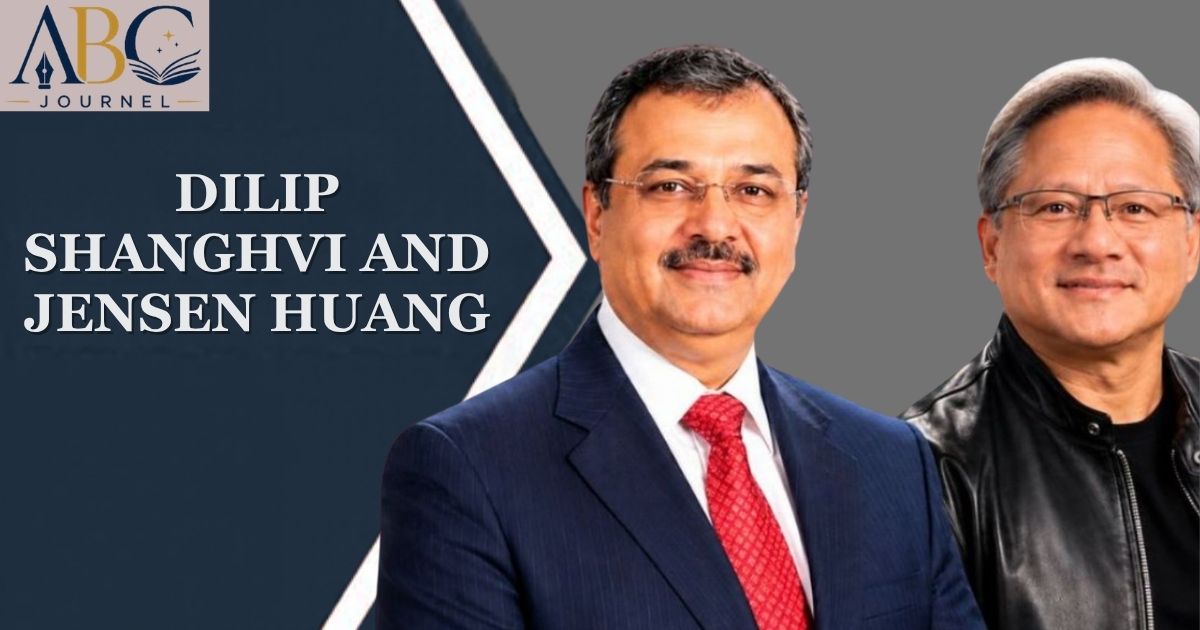
Dilip Shanghvi and Jensen Huang: Stories of Success

Dilip Shanghvi and Jensen Huang come from different countries, industries and generations. One built India’s largest pharmaceutical company. The other built the company that powers modern artificial intelligence. Yet their paths share a surprising number of lessons.
This guide compares Dilip Shanghvi and Jensen Huang side by side. You will learn who they are, how they built Sun Pharma and NVIDIA, how they lead, and what founders can learn from each. The data here was checked against company records, business press and biographies, and it is current as of November 2026.
Who Is Dilip Shanghvi?
Dilip Shanghvi is an Indian businessman and the founder of Sun Pharmaceutical Industries. He was born on 1 October 1955 in Amreli, Gujarat. Britannica lists him as the founder of Sun Pharmaceutical Industries in 1983.
Early Life and Education
Shanghvi grew up in a business family. His father ran a wholesale medicine distribution business in Kolkata. Dilip studied commerce at the University of Calcutta and started helping in the family shop. That early exposure taught him how drugs are sourced, priced and sold.
Key Facts at a Glance
- Born: 1 October 1955, Gujarat, India
- Known for: Founding Sun Pharma
- Starting capital: About ₹10,000
- Honor: Padma Shri, India’s fourth highest civilian award (2016)
- Biography: The Reluctant Billionaire by Soma Das (2019)
- Current role: Executive chairman of Sun Pharma, after a 2025 leadership reshuffle
He is also known for staying out of the spotlight. Colleagues and journalists often describe him as quiet, numbers driven and patient.
Who Is Jensen Huang?
Jensen Huang is the co-founder, president and CEO of NVIDIA. He was born on 17 February 1963 in Tainan, Taiwan. His family later sent him and his brother to the United States, where Huang grew up in Oregon and Kentucky.
Early Life and Education
Huang’s early years in the US were not easy. He attended a rural boarding school in Kentucky and, by his own telling, worked menial jobs, including washing dishes at a Denny’s restaurant. He earned a bachelor’s degree in electrical engineering from Oregon State University and a master’s degree from Stanford University.
Career Before NVIDIA
Huang worked at LSI Logic and Advanced Micro Devices (AMD) as a chip designer and engineer. He learned how semiconductors are designed, sold and manufactured. That knowledge shaped everything he did next.
Key Facts at a Glance
- Born: 17 February 1963, Taiwan
- Known for: Co-founding NVIDIA in 1993
- Education: Oregon State University and Stanford University
- Company milestone: NVIDIA became the first company to reach a $5 trillion market value
- Wealth: Reports in October 2026 put his net worth above $200 billion, though estimates change daily with NVIDIA’s share price
How Dilip Shanghvi and Jensen Huang Built Their Companies
Both men started small and grew through focus. The tools they used were very different.
Dilip Shanghvi: Building Sun Pharma Step by Step
Shanghvi launched Sun Pharma in 1983 in Vapi, Gujarat. Business Today reports he began with just ₹10,000 and a focus on psychiatry products. He chose a narrow niche on purpose. Few Indian firms served psychiatrists, so Sun faced less competition.
Here is how the company grew:
- 1983: Sun Pharma is founded with a small product line.
- 1994: The company goes public through an IPO.
- 1997: Sun buys Caraco, a Detroit generics company. This gave it a foothold in the US market.
- 2007 to 2010: Sun takes control of Taro Pharmaceutical in Israel after a long takeover fight. It completed a full merger with Taro in 2024.
- 2014: Sun agrees to buy Ranbaxy in a deal valued at around $4 billion including debt. This made it India’s largest pharmaceutical company and among the top global generic drug makers.
- 2020s: Sun expands into specialty medicines, especially dermatology.
Wikipedia’s current entry reports Sun’s FY26 revenue at Rs 58,220 crores with net profit of Rs 11,479 crores.
Jensen Huang: Building NVIDIA Around a Bet
Huang, Chris Malachowsky and Curtis Priem founded NVIDIA in 1993. The founding story is famous: the three met at a Denny’s in San Jose to plan a company that would make graphics chips for 3D gaming.
The early years were hard. NVIDIA nearly ran out of money in the mid 1990s. Then the company bet everything on a new chip and survived.
Key milestones:
- 1993: NVIDIA is founded.
- 1999: The company goes public and launches the GeForce 256, which NVIDIA marketed as the first GPU.
- 2006: NVIDIA releases CUDA, which lets developers use GPUs for general computing.
- 2012: Researchers use NVIDIA GPUs to train AlexNet, a landmark moment for deep learning.
- 2020s: Data center and AI chips such as Hopper and Blackwell drive record revenue.
- 2025: NVIDIA becomes the first public company to reach $5 trillion in market value.
Leadership Styles and Business Philosophies
Their styles look different on the surface. Underneath, they share a few habits.
Shanghvi: Patient, Quiet and Calculated
Shanghvi is known for choosing deals carefully and then fixing what he bought. Caraco was a loss making company when Sun acquired it, and Sun turned it around. His approach to leadership includes:
- Buy and fix: Acquire struggling firms with useful assets, then improve operations.
- Stay lean: Keep costs low and watch margins closely.
- Plan succession early: He handed the CEO role to outsider Israel Makov in 2012 and later moved to executive chairman.
- Choose the long game: Specialty drugs take years to develop, and he has funded them anyway.
Huang: Hands On, Technical and Bold
Huang is known for deep technical involvement and a flat organization. Many reports describe him as someone who prefers direct conversations over layers of management. His approach includes:
- Bet early on a platform: CUDA was a risky investment that paid off years later.
- Build an ecosystem: NVIDIA sells chips, software, networking and developer tools together.
- Move fast: Product cycles are short, and the company plans years ahead.
- Be visible: Huang’s keynotes and signature black leather jacket have made him a public face of AI.
Shared Principles
Both leaders:
- Focused on a core strength before expanding
- Survived hard early years
- Reinvested profits into research and growth
- Built teams that could operate without them
Innovation, Challenges and Global Influence
Innovation
Sun Pharma’s innovation is mostly about access and scale. It makes affordable generics and has grown a specialty portfolio, including skin care treatments sold in the US. Sun Pharma Advanced Research Company (SPARC) works on new drug delivery and discovery.
NVIDIA’s innovation is about computing itself. GPUs, CUDA and AI platforms changed how scientists, car makers, hospitals and tech giants process data.
Challenges
Both companies faced serious setbacks.
Shanghvi’s challenges:
- Regulatory scrutiny from the US Food and Drug Administration at some plants
- Integration risk after the Ranbaxy deal, which came with legal and quality problems
- Pricing pressure in the global generics market
Huang’s challenges:
- A near collapse in NVIDIA’s early years
- Export controls and geopolitical tension around chip sales to China
- Public debate over whether the AI boom is a bubble. Huang has publicly rejected that view
Global Influence
Sun Pharma sells medicines in more than 100 countries, according to Business Today. Its products reach patients who depend on affordable treatment. NVIDIA’s influence is broader and more visible. Its chips sit inside the data centers behind most major AI services, and its stock moves global markets.
Dilip Shanghvi and Jensen Huang: A Comparison
Here is a clear side by side view.
| Factor | Dilip Shanghvi | Jensen Huang |
| Company | Sun Pharma | NVIDIA |
| Founded | 1983 | 1993 |
| Industry | Pharmaceuticals | Semiconductors and AI |
| Country | India | United States |
| Growth strategy | Acquisitions | Product and platform innovation |
| Public profile | Low | High |
| Current role | Executive chairman | Co-founder and CEO |
| Key honor | Padma Shri (2016) | Global recognition as an AI industry leader |
What They Have in Common
- Both are immigrant or first generation self-made founders from modest starts
- Both entered niche markets before going global
- Both built businesses worth tens of billions of dollars
- Both stayed with their companies for decades
Where They Differ
- Speed: Huang’s industry moves in months. Shanghvi’s moves in years.
- Method: Shanghvi grew by buying companies. Huang grew by inventing products.
- Visibility: Shanghvi avoids publicity. Huang embraces it.
- Succession: Shanghvi has openly prepared a handover. Huang still leads NVIDIA day to day.
Lessons Entrepreneurs Can Learn
- Start narrow. A small niche can become a launchpad.
- Survive first. Both founders endured years of risk before success.
- Invest ahead of demand. CUDA and Sun’s US expansion both looked costly at first.
- Build for the long term. Neither company was an overnight success.
- Plan for succession. Good founders make themselves replaceable.
Frequently Asked Questions
Who is Dilip Shanghvi?
Dilip Shanghvi is the Indian founder of Sun Pharmaceutical Industries and a Padma Shri recipient. He started the company in 1983 and built it into India’s largest drugmaker.
Who is Jensen Huang?
Jensen Huang is the Taiwanese American co-founder and CEO of NVIDIA. He leads the company behind many of the world’s leading AI chips.
How did Dilip Shanghvi start Sun Pharma?
He started it in 1983 with about ₹10,000 and a handful of psychiatry products. He then grew it through acquisitions such as Caraco, Taro and Ranbaxy.
How did Jensen Huang start NVIDIA?
He co-founded NVIDIA in 1993 with Chris Malachowsky and Curtis Priem to build graphics chips. The company later pivoted into AI computing.
Which company is bigger, Sun Pharma or NVIDIA?
NVIDIA is far larger by market value, having passed $5 trillion. Sun Pharma is India’s largest pharmaceutical company by revenue.
What is Dilip Shanghvi’s current role?
He became executive chairman of Sun Pharma in September 2025. Kirti Ganorkar is the managing director, and his son Aalok Shanghvi serves as chief operating officer.
What is Jensen Huang’s net worth?
Reports in October 2026 put it above $200 billion, though it moves with NVIDIA’s share price. Check Forbes or Bloomberg for the live figure.
What is the main difference between their leadership styles?
Shanghvi is a quiet, acquisition focused leader. Huang is a hands on, technology driven public figure.
What can young founders learn from both?
Focus on a niche, survive early setbacks and invest ahead of demand. Also plan for the day you step back.
Conclusion
Dilip Shanghvi and Jensen Huang prove that there is more than one path to building a world class company. Shanghvi grew Sun Pharma patiently through smart acquisitions in an industry that rewards discipline. Huang took bold technical bets that made NVIDIA the center of the AI economy.
Their stories share a common thread. Both began with limited resources, picked a clear focus and kept investing through hard years. For entrepreneurs, that is the real takeaway: start small, think long and build something that can outlast you.
I’m Rimsha Rabail, an experienced Content Writer and Celebrity Biography Specialist with 5 years of professional writing experience. I create compelling Celebrity Biographies, Public Figure Profiles, Entertainment Articles, and SEO-Driven Content. With a strong focus on research, accuracy, originality, and storytelling, I aim to produce informative content that connects with readers and meets modern digital publishing standards.